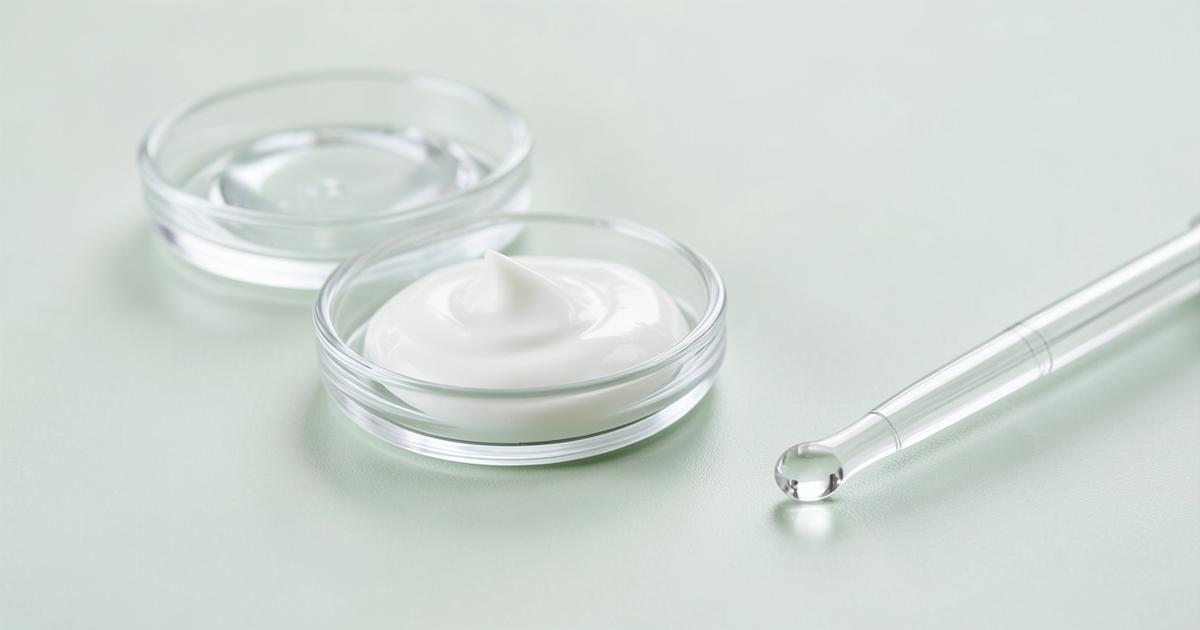
What Sodium Hyaluronate does
HA holds many times its weight in water. On skin it draws moisture into the outer layers, which visibly plumps fine dehydration lines within minutes.
The effect is temporary and topical. It does not repair the barrier the way lipids do, and it does not change pigmentation, acne or wrinkles.
Different molecular weights are marketed as penetrating to different depths; in practice the mix mostly changes how the serum feels.
Worth using if…
- Tight, dehydrated skin of any type
- Layering under a moisturiser
- Buffering irritation from retinoids and acids
Safety & watch-outs
- In very dry air, a humectant with nothing sealed on top can pull water out of skin. Always follow with a moisturiser.
- Applying to damp skin works better than to bone-dry skin.
Sodium Hyaluronate in pregnancy: Not on standard avoid lists
Not on standard pregnancy avoid lists.
Fungal acne (): does not feed it
Humectant, not a lipid. The fungal-acne yeast feeds on fatty acids roughly C11–C24 and the esters built from them, so what matters in a finished formula is the whole list, not one ingredient.
Check a whole formula for malassezia triggers →Comedogenic rating: 0/5 · non-comedogenic
Non-comedogenic. Ratings come from the published Fulton scale, which was measured on rabbit ears rather than human faces — treat it as a rough signal, not a verdict on a finished formula.
Check a whole formula for pore cloggers →Common questions
Is hyaluronic acid an exfoliating acid?
No — despite the name it does not exfoliate at all. It is a moisture-binding sugar.
Informational only, not medical advice. Written from public regulatory and dermatology references (EU Cosmetics Regulation annexes, SCCS opinions, CIR reviews, published Fulton-scale data). Concentration, formula and your own skin all change the outcome — consult a clinician for personal concerns.
Related ingredients
All ingredient explainers
AllantoinAlpha ArbutinAvobenzoneAzelaic AcidBakuchiolBenzoyl PeroxideCentella Asiatica ExtractCeramidesCoconut OilDimethiconeGlycerinGlycolic AcidL-Ascorbic AcidLactic AcidNiacinamidePanthenolPeptidesRetinolSalicylic AcidSqualaneTitanium DioxideTranexamic AcidUreaZinc Oxide